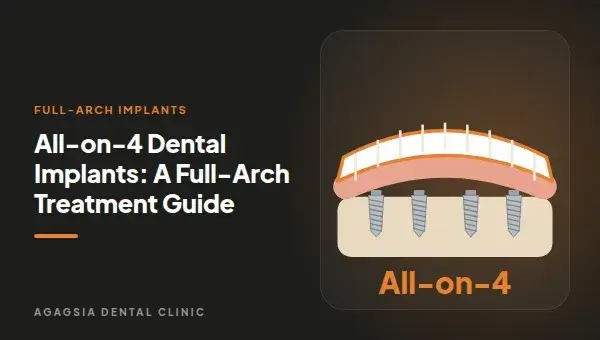
All-on-4 describes a full-arch concept in which a dental prosthesis is supported by four implants. It may be considered for people who have lost, or are expected to lose, most teeth in one jaw. The term does not replace diagnosis: bone distribution, anatomy, bite forces, remaining teeth, gum health and expectations all influence the final design.
Who may be considered?
Potential candidates may have extensive tooth loss, failing teeth or difficulty using removable dentures. Assessment must determine whether remaining teeth can be predictably treated, whether there is adequate bone in suitable positions and whether medical or behavioural factors increase risk. Alternative plans may include preserving teeth, removable options or a different number of implants.
Why implant position matters
The four implants are planned to distribute support across the arch while avoiding anatomical structures. Three-dimensional imaging may be needed. The prosthetic design should be planned before surgery because tooth position, lip support, cleaning access and bite affect implant placement. “Four implants” is therefore only one part of the treatment.
Temporary and definitive teeth
Where adequate stability and other criteria are met, a fixed temporary prosthesis may be fitted soon after surgery. It is a healing restoration, not necessarily the final bridge. A softer diet and careful cleaning may be advised. After healing, the definitive prosthesis is produced, fitted and adjusted according to tissue changes and the established bite.
Travel and treatment stages
Full-arch care commonly involves records and planning, surgical treatment with a provisional phase, healing, and a later definitive restorative phase. The number and length of trips vary. Patients should allow time for checks and adjustments instead of treating the final day as a guaranteed departure point.
Risks and maintenance
Possible complications include surgical risks, failure of one or more implants, fracture or wear of provisional teeth, speech or bite adaptation, hygiene difficulty and inflammation around implants. A fixed bridge still requires cleaning beneath it with suitable aids. Regular recall and professional maintenance are part of treatment, not optional extras.
Consultation Call to Action
Send available X-rays and photographs for a preliminary full-arch review. Implant number, loading protocol and final design are confirmed after clinical and radiographic assessment.