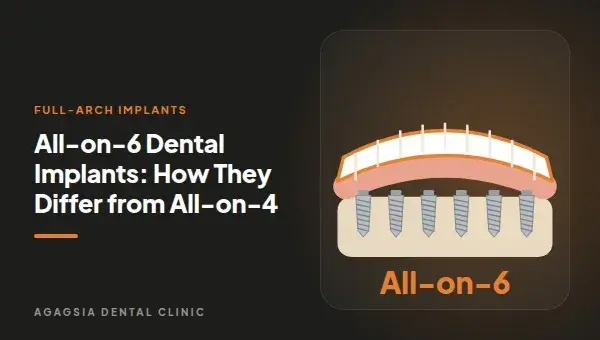
All-on-6 is a label for a full-arch restoration supported by six implants. Patients often compare it with All-on-4 and assume that six must always be better than four. In reality, the appropriate number and position of implants depend on available bone, anatomy, restorative space, bite forces, planned prosthesis and the consequences if an implant is lost.
All-on-6 and All-on-4 compared
Both concepts can support a fixed full-arch prosthesis. Six implants may provide additional support or distribution in an appropriate jaw, while four may be selected when anatomy and the prosthetic plan favour that approach. Additional implants also require suitable bone and surgical access. The decision should be explained using the patient’s scans and proposed restoration.
Assessment before treatment
The team reviews teeth, gums, smile line, jaw relationship, bone, medical history, smoking and oral hygiene. Digital scans, photographs and three-dimensional radiographic assessment may be indicated. Any extraction, grafting, sinus-related planning or treatment of infection should be included in the written plan.
The provisional phase
If immediate loading criteria are met, a provisional fixed restoration may be fitted. It protects appearance and function during healing but can require adjustment or repair. Patients normally receive diet and hygiene instructions. The final bridge is planned after tissues have stabilised and the clinical team confirms integration.
Materials and final bridge design
Definitive full-arch restorations can use different frameworks and tooth materials. Zirconia is one option; other designs may be indicated depending on space, opposing teeth, repair strategy and bite. Patients should understand what is temporary, what is definitive, how the bridge can be maintained and what future servicing may involve.
Long-term care and complications
Implants and bridges can develop biological or mechanical complications. Plaque accumulation may inflame surrounding tissues; screws, teeth or framework components can loosen, wear or fracture. Regular professional reviews allow hygiene, bite and components to be checked. Bruxism may lead to a protective appliance recommendation.
Consultation Call to Action
Ask for an individual All-on-4 versus All-on-6 comparison based on your X-rays, anatomy and restorative goals. Final planning follows in-clinic diagnostics.